Sunday, October 9, 2022

Galactic Distances in Warhammer 40k

I've been trying to figure out the galactic distances between planets in Warhammer 40,000. We know the Eye of Terror corresponds to Cygnus X-1 (approximately 7,300 ± 200 light years away from Earth). The book The Horus Heresy Book III - Extermination gives a map of the galaxy with a hex grid background. We can reproduce the fragment involving the Eye of Terror and Holy Terra below:

I have computed the center of mass for the Eye of Terror (assuming uniform density) and drawn a straight line connecting Terra to the center of the Eye of Terror. Along this line, I have marked distances which are multiples of the edge for a hexagon. Since the Eye of Terror is approximately 8.4 hex-sides away from Holy Terra, it follows that a hex grid side length is 869 ± 23.8 light years.

Result: The side of a hexagon is 869 ± 23.8 light years.

Now, for the interesting systems to the "East" of Terra:

Again, we use circles to mark "milestones" whose distance is 1 hex-side length.

We find that Prospero is sqrt(57) ≈ 7.55 hex-sides away from Terra which would be 6560.80 ± 179.686 light years away from Holy Terra.

The Davin system is about sqrt(156) ≈ 12.489996 hex-sides away from Terra, which would be 10853.80652 ± 297.262 light years away from Holy Terra.

If this is accurate, then the distance between Prospero and Davin is approximately sqrt(27) ≈ 5.196 hex-sides, which would be 4515.45645 ± 123.668 light years.

Anyways, I'm interested in Davin's distance from Terra because Guilliman (and friends) fought the Second Battle of Davin before rushing to Terra to relieve Dorn, Sanguinius, and the Khan. I've been curious about the distances and time intervals, mostly as an excuse to generate exercises in special relativity. Assuming the distances measured are radar distances, the proper speed for Guilliman's relief force would be about 3618c (i.e., 3618 times the speed of light) and relative to an inertial observer on Terra Guilliman's speed would be about 3618/sqrt(36182 + 1) ≈ 0.9999999618026812 times the speed of light.

Objection: These calculations all work in flat geometry, which we know is false due to General Relativity.

Response: While this is true, the curvature due to general relativity is so slight, the corrections would be negligible. One more compelling reason to use general relativity would be to observe the galaxy is rotating, which means we'd need to use a non-inertial reference frame. But this is so small as to be negligible.

A better objection would be the location of these planets are not in the direct center of the hexagons. Assuming a uniform distribution of offset within the hexagon, we obtain an uncertainty of 16*sqrt(2)*(1/3 - sqrt(3)/8)/(4 + ln(27)) hex-sides ≈ 314.864 ± 8.623 light years in the distances between any two planets.

(The math behind this is simple, just take M = \int^{1/2}_{0}\sqrt{y^{2} + \frac{3}{4}}\,\mathrm{d}y = (4 + \ln(27))/16 as the normalization constant for the probability distribution Pr(y) = \sqrt{y^{2} + \frac{3}{4}}/M, then we find E[y] = \int^{1/2}_{0}y Pr(y)\,\mathrm{d}y = \frac{16}{4 + \ln(27)}\left(\frac{1}{3} - \frac{\sqrt{3}}{8}\right) as the expected offset. Another approach would be to consider a uniform distribution over the hexagon, then find the variance. I believe this would give an uncertainty of 1.01958 side lengths ≈ 886.015 ± 24.2660, but I should work through this more carefully. For the uniform distribution on the unit circle, we would have the variance of the radius be 5/18, corresponding to 458.003 ± 12.544 light years.)

Objection 2: In Angel Exterminatus, Perturabo notes that Cygnus-X was a name "re-used" on a different celestial body than it was originally named, so all these calculations are wrong.

Response 2: True, Perturabo made that "observation", but it makes no sense. Cygnus-X is literally the first confirmed black hole that humans have discovered, and that would not be easily changed. It would be as if "Mars" nows designates Alpha Centauri.

Again, a better objection would be that I have confused Cygnus X with Cygnus X-1, which would just rescale the distance of a hex edge by about 46/73 ≈ 63%, or 547.59 ± 15 light years.

Another way to estimate distances is to first identify the center of the galaxy, then find Earth (holy Terra). This will be approximately 27,000 light years. (Our current best estimate is that the Solar system is a distance of 8.33 ± 0.12 kpc ≈ 27168.83 ± 391.3877 light years, see Eq (2) of arXiv:1611.09144.) As a consistency check, it appears that Terra is about hex edges away from Sag A*, which would make Terra about 22 hex edges away from (what I think is) Sag A*, which would be an estimated 19118 ± 523.6 light years away...which means we'd need to increase each edge length by about 42% to 1235 ± 17.8 light years. [Using this estimate: The Eye of Terra is 10,374 ± 149.52 light years from Terra, Prospero is 9324 ± 134.4 light years from Terra, Davin is 15425.15 ± 222.32 light years from Terra, and Guilliman would have traveled at a proper speed of 5141 ± 74 times the speed of light. This also fits the claim "Armageddon is 10,000 light years from Terra" better, I believe.]

It would be interesting to compare the various maps from the different books, to check if they are all mildly consistent with distances, and specifically to examine the locations of various "known" bodies (e.g., Armageddon is supposedly 10,000 light years from Terra — is this just poetic hyperbole, or an accurate order-of-magnitude estimate?).

Thursday, September 22, 2022

Miniature Heights in Warhammer 40k

I've been thinking about miniature heights and scales in Warhammer 40k, because the game uses an idealized representation of distance (rather than an actual scale). This is because, if we tried using a realistic scale, the height of a human being 2 meters but represented by a 1 inch model...well, we end up with Bolters having an effective range of 550 meters, which would be 275 inches (compared to, what, 24 inches in the game).

Working the other way around, suppose the 24 inch range is the correct scaled distance. Then a 2 meter tall human would be represented by an approximately 2.2 millimeter tall figure.

Suppose we accept the idealized distances for weapons, but want more realistically scaled figures. How tall should they be? First let us try to consolidate what we know about various heights.

  • Adeptus Custodes are 9 feet tall, without their helmet on.
    • This is straight from the 7th edition Codex, They tower over mortal men; each has the statuesque physique of an ancient hero, close to nine feet in height even without his scarlet-crested helm.
    • Repeatedly in the book The Gate of Bones, the Custodes with helmet on is described as 10 feet tall and the helmet gives an extra foot of height.
    • Primaris Space Marines: First Impressions measures the Custodes miniature to be approximately 1.25 inches without a head, comparable to a Primaris miniature, but the Custodes has a wider stance.
  • Space Marines are between 7 feet tall and 7.5 feet tall. (It seems to have settled on using 7 feet as their height.)
  • Primaris Space Marines are 8 feet tall
    • Repeatedly in the book The Gate of Bones, the Primaris marines are referred to as standing 8 feet tall.
  • Primarchs seem to be around 3 meters tall, give or take "a head".
    • Lion El'Johnson is described as slightly less than three meters tall in Descent of Angels: The Lion was a truly imposing physical specimen. A giant, standing at a little under three metres tall, it was impossible to escape the suspicion that he had been cut from a broader canvas than the majority of men. His body was perfectly proportioned and entirely in scale with his height. He was powerfully built, lithe yet muscular. (Emphasis added)
    • Ferrus Manus stood a head taller than his brothers, as stated in Fulgrim: Ferrus Manus, clad in his shimmering fuliginous armour, stood a head taller than his brothers, pacing like a caged Medusan snow lion as he awaited news of the rest of his Legion. (Emphasis added)
  • The Emperor, people claim online, is 14 feet tall...which I find hard to believe, but whatever
  • Warhound Scout Titan (apparently the model is 250mm tall)
    • 14 meters tall, at rest

Of course, these are fantastical sizes. I'm not sure if 1 foot in 40k corresponds to our notion of a foot, because people are apparently shorter (around 5 feet tall for the average human). If we scale things appropriately, one "40k-foot" is then 5/6 of a "normal foot", or "1 40k-foot = 10 inches". Then a space marine is about "6 normal feet" tall, but Custodes are about "7.5 normal feet" tall (slightly taller than Shaquille O'Neal). This may also be just my own rationalization.

HO Scale

If we stick to the prescribed heights using "normal feet", and if were using HO scale, where 3.5 millimeters represents 1 foot, then we would have figures of the following sizes:

  • Adeptus Custodes would be 31.5mm tall figure without the helmet (and 35.0345mm with the helmet)
  • Space Marine would be between 24.5mm and 26.25mm tall figure (we could round to make it an even 1 inch figure)
  • Primarchs would be (3.5mm/foot) × 9.84252 feet = 34.44882mm tall figure, Ferrus Manus would be (9/8)×34.44882mm = 38.7549225mm; a primarch who is a head shorter than the Lion would be represented by a (3.5mm/foot) × (7/8) × 9.83252 feet = 30.1427175mm tall figure

The 10.3 meter long Land Raider would be represented by a 118.274mm long miniature (or approximately 4.65646 inches).

1:60.96 Scale

Continuing with the "normal feet" assumption, the scale Games Workshop appears to use is roughly 1:60.96 scale (5mm per foot, or 1cm per 2 feet). We can verify this by examining a Land Raider which is supposed to be 10.3m long, but the model is about 17cm long, gives us a scale of 1:60.5882 [if the model is 16.8963cm long, then it is indeed 1:60.96 scale].

  • Adeptus Custodes would be 45mm tall figure without the helmet
  • Space Marine would be about 35mm tall figure
  • Primarchs would be (5mm/foot) × 9.84252 feet = 49.2126mm tall figure, Ferrus Manus would be (9/8)×49.2126mm = 55.364175mm; a primarch who is a head shorter than the Lion would be represented by a (5mm/foot) × (7/8) × 9.83252 feet = 43.061025mm tall figure

S Scale

If we use the S Scale (i.e., the 1:64 scale), then we would have 4.7625mm model 1 foot. The 10.3 meter long Land Raider would be represented by a 16.0938cm-long model.

  • Adeptus Custodes would be 42.8625mm tall figure without the helmet
  • Space Marine would be about 33.3375mm tall figure
  • Primarchs would be (4.7625mm/foot) × 9.84252 feet = 46.875mm tall figure, Ferrus Manus would be (9/8)×46.875mm = 52.73mm; a primarch who is a head shorter than the Lion would be represented by a (4.7625mm/foot) × (7/8) × 9.83252 feet = 41.015mm tall figure

Tuesday, August 30, 2022

Imperial Palace Dimensions

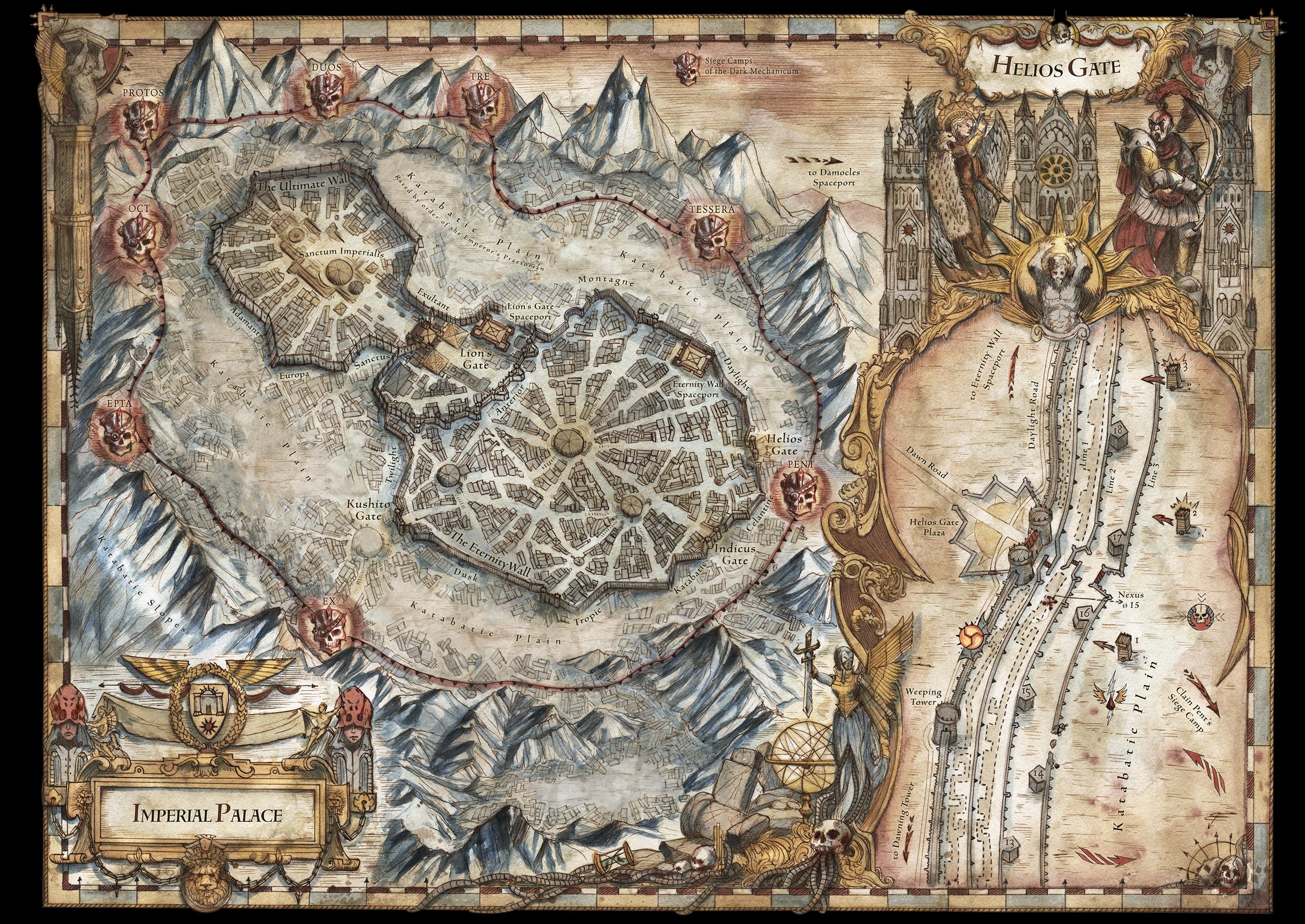
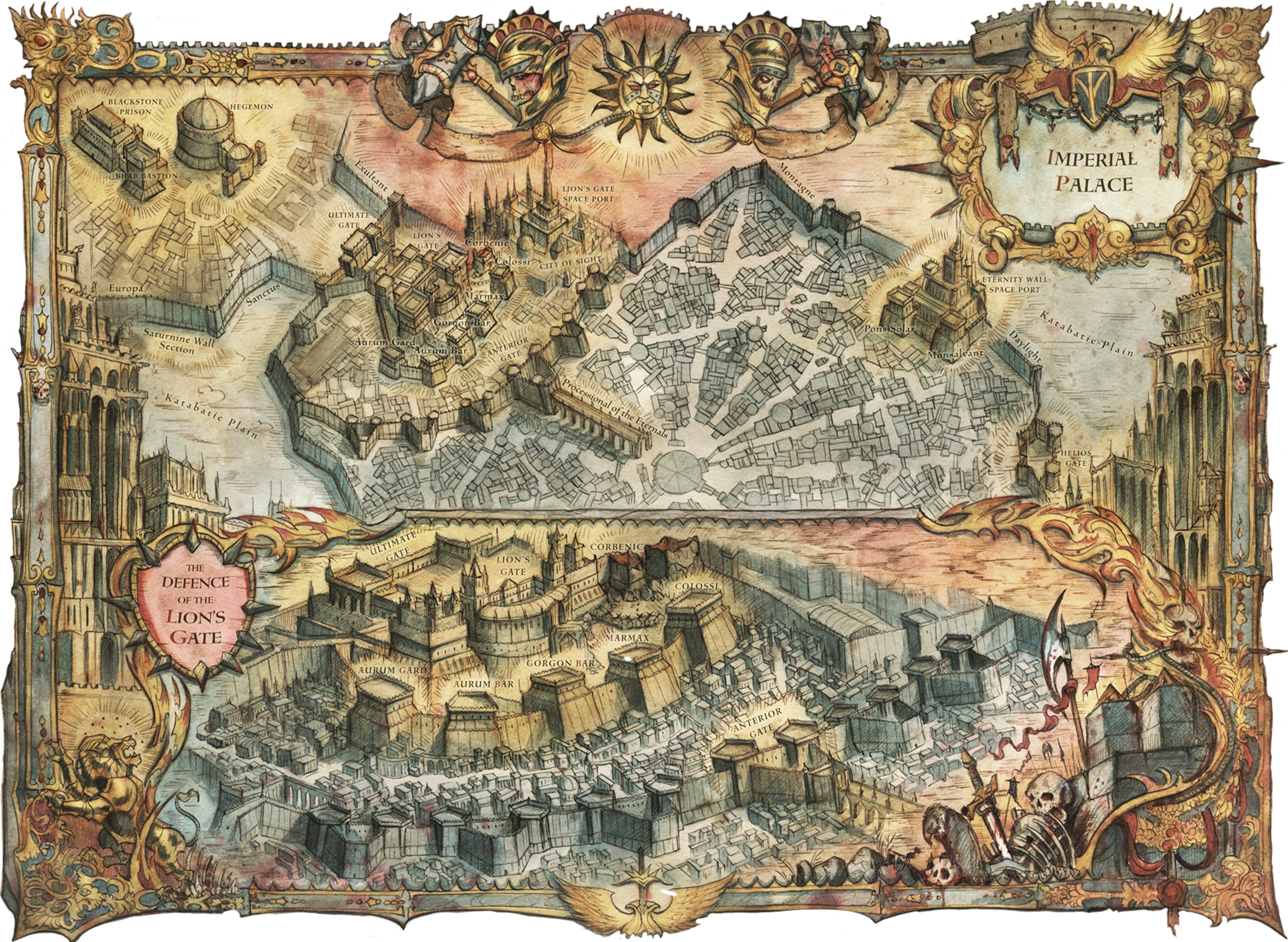
While reading through the Siege of Terra book series, I wondered what were the dimensions of the Imperial Palace. It has a rougly Motte and Bailey design, where the bailey is called the "outer palace" (bounded by the Eternity Wall) and the keep is called the "inner palace" (bounded by the Ultimate Wall).

Puzzle: What are the dimensions of the Imperial Palace?

Understandably, they are seldom discussed, because people would complain about its various dimensions being unrealistic. However, in the fifth volume in the series, Mortis, in chapter 4 of part I (pg.107 in the hardback edition):

Now, they would simply make the whole circuit of the Ultimate Wall, all thirteen hundred kilometers of it.

From this, we can get bounds on the dimensions of the inner palace. The largest area enclosed within a given permiter is a circle (we know this from the Isoperimetric problem, since ancient Greece). That is to say, we would have the circumference equal to 1300 kilometers, giving us a radius of approximately 206.9 kilometers and diameter of approximately 413.8 kilometers; these are the lower upper bounds. (The area enclosed would be 134,485.95691 square kilometers.)

The official map makes the inner palace look more like a square, which would then give a side-length of approximately 325 kilometers. The area enclosed would be 105,625 square kilometers.

Addendum: There are ways to elongate the shape of the Inner Palace to produce inflated length. This is a pathological approach which, although possible, does not faithfully reflect the maps produced of the Imperial Palace. I thought it worth explicitly mentioning, that it has been considered and dismissed.

Objection: Earth is Curved. One may object the Earth is curved, but this negligibly affects the calculations involved at this scale. If we used the latitude/longitude coordinates as points in the Cartesian plane for the nation of China, then our error would be on the order of 1%. The Imperial Palace is on a slightly smaller scale. Our estimates would be off by a fraction of a percent, which is an acceptable error range (for me).

Observation of an inconsistency. We also read in Mortis, in chapter 6 of part I (pg.136 in the hardback edition):

Mercury wall, two hundred kilometres of defences that stood almost intact.

This makes the map associated with the Imperial Palace problematic, if taken to scale. Why? Because the inner palace is approximately a rectangle of scaled proportions 11-by-9. If we remove the portion of the wall for the Ultimate Gate, we would find a perimeter of 2084 kilometers. (See, this is why distances are seldom given as exactly as the quoted portions.)

Or, if the map is to scale, then the Mercury wall should be approximately 121.33 kilometers long.

Solutions. In my demented mind, it makes most sense to approximate the perimeter as a square, and make the Eternity gate a little bit smaller on the map drawn. That is to say, the Eternity gate is enlarged on the map for emphasis and clarity, but the map is roughly "to scale". This makes the Sanctus wall and the gap for the Eternity gate together 125 kilometers or so.

Or we could take the map drawn to scale, which would make the gap for the Eternity gate approximately 114 kilometers. Then the perimeter for the region (not just the wall, but also the gap) 1414 kilometers, and the inner palace would be approximately circular with radius 225 kilometers (bigger by nearly 16 kilometers) and diameter 450 kilometers. Its area would be about 159,106.8783 square kilometers (compared to our earlier result of 134,485.95691 square kilometers).

Estimate of Outer Palace. The area of the Outer Palace appears to be twice that of the inner palace. Again, a circle would maximize the area bounded by the perimeter. This would give us a radius bigger than our estimates for the inner palace by a factor of the squareroot of 2 (about 40% larger). Concretely, this would be roughly a circle of radius 320 kilometers, diameter 640 kilometers, and area of about 318,000 square kilometers.

Neglecting the region taken up by the Eternity Gate, this would be 1090 kilometers long [677.3 miles long]. To get some sense of this, I saunter slowly at 2 miles per hour (a very leisurely pace). It would take me 338.6473 hours to walk that distance; if I were walking 8 hours a day, that's 42 days plus a few hours. Most people walk at 3 miles per hour, which would require 225.76 hours to walk the distance [at 8 hours per day, that's 28 days plus change].

Estimate of the Eternity Gate region. The map makes it look like a rectangle approximately 4.5-units wide, 5-units long. It is approximately as wide as the Sanctus wall and the gap (which we estimated as 228 kilometers combined). This would make it approximately 253 kilometers long.

Taken together, this means the Imperial Palace is approximately 1,343 kilometers long. Notice this is also the length of the Eternity wall (curiously enough!).

Reality Check. The Himalayas, we are told, are approximately 2,400 kilometers long. Thus the Imperial Palace would take up half the Himalayas (approximately).

Exercise for Reader. If we want to preserve the proportions given and estimated, but wanted to make the Imperial Palace 2,400 kilometers long, then what changes must be made to the lengths reported by the books?

Friday, July 29, 2022

Warhammer Campaign and Mission Ideas

When I was in secondary school, I played Warhammer (both fantasy and 40k). I've been dabbling in it again — this time using wooden cubes instead of expensive miniatures. Since this is my "gaming blog" (I guess), I thought I'd write down some thoughts about campaigns and missions.

Narratives and Campaigns

Some time after 6th edition of 40k, Games Workshop introduced strategems and "narrative campaigns". I don't fully understand what these mean, so I will ignore them. Instead I will discuss different ways to structure campaigns I've enjoyed.

Path to Glory

Back around White Dwarf issue 275 or so, there was a free supplement called Path to Glory. You started with a Chaos warlord, and you built your war band from scratch using dice rolls and tables. The exact initial setup was the same for everyone, you start off with 35 "favor points" and then:

  • Step 1: your warlord. Your warlord starts off with basic gear, but you can use 1 favor point to get gear (you roll 1d6 and use a table of possible gear)
  • Step 2: your gods. You pick a Chaos God to follow (or you can worship them all equally); this is done once and cannot be undone.
  • Step 3: Form a war band. You need at least two groups [squads] of followers. You get followers by spending favor points to roll a die and use particular tables. If you use 1 favor point, you use the "more common follower" table; if you use 3 favor points, you can use the "awesome follower" table.
  • Step 4: Play a game! You play against others, and accumulate favor points by accomplishing various goals. You then use favor points to build up your war band further.

I really liked the feeling of building up an army from scratch. This guided my approach to structuring game play; for example,

  • Orkz: you are a nob trying to become a warlord. Or you're a Mek, trying to become a Big Mek.
  • Space Marines: you are a sargeant working his way up to higher rank; or a tech-marine trying to gather artifacts (or whatever they do); or an apothecary doing...apothecary-stuff.
  • Adeptus Mechanicus: you are a lowly tech priest trying to find artifacts and research sufficient to win favor and your own fabulous new car Martian forge.
  • Imperial Guard: you are a second-lieutenant given command of a platoon, rising through the ranks.
  • Inquisition: you're a paper/button pusher (or whatever they have in the 40th millenium) given a field job. (That's how inquisitors start out, right? Or is this like the Freelance Police where anyone with a gun can claim to be apart of it?) In either case, you start off with nearly nothing, and working your way up to Space Pope CEO of the Inquisition.
  • Sisters of Battle: you're a sister superior, working to fight Chaos.
  • Adeptus Custodes: ...wait, that's a "thing" now?
  • Chaos Space Marines: this is pretty much the same as Path to Glory, isn't it? You could be a "goodie two shoes" space marine who has fallen to evil ways, or a "vintage" 30k traitor.
  • Necron: you are some minor dignatary of your dynasty, trying to accumulate more power to guide your dynasty to power.
  • Dark Eldar: you're a space elf pirate "captain" of a pathetic vessel, or you're a petty officer of one, trying to accumulate enough to form your own mighty pirate fleet.
  • Eldar: are you an exodite? Or a corsair? Or a craft world? Perhaps you aspire to join the Harlequins? You hate chaos [or Necrons, or...] and you're forming a gang ranking up in the military to fight it (or whatever).
  • Tyrannids: you're a bug.
  • Tau: pick a caste, get some followers, and find out the real empire is the friends you make along the way.

In many cases (e.g., Imperial Guard, Sisters of Battle, Tau, probably also Eldar, etc.), for this approach to campaign building to work, then you need a "Game Master" who will set up an over-arching narrative. Why? Because the player is literally working at the "tactical level", and someone needs to fit it into an overarching strategy.

For others (e.g., Orkz, Chaos Space Marines, Adeptus Mechanicus, Dark Eldar, etc.), it's pretty self-sufficient for motivation: you're trying to smash other players (or, for Adeptus Mechanicus, accumulate artifacts).

I was always intrigued with the Orkz. You could be following the footsteps of Ghazghkull, trying to unite a planet to then lead a WAAAAAGH somewhere. Or you could be following the footsteps of Orkimedes (I love that name), trying to become a better Mek. (Or you could be a Dok trying to gather the resources and skills to become a better Dok.) Or you could be a speed racer trying to get parts to make his truk go faster.

(My favorite backstory for an Ork Mek: a tech-priest got hit on the head, and when he came to, he awoke amidst orks. The Tech-Priest then believes he is an Ork. Thus we got some fascinating backstory for a Mek. Disclaimer: I stole this from some guy, who posted it back 15 years ago or so, as a backstory to Orkimedes...I just can't find where it went on the internet.)

If you just look around, you can find inspiration for campaigns all around you.

Black Library Ideas

You can "take a page" from Black Library books: their plots literally consist of missions and campaigns.

The Infinite and the Divine revolved around stealing one artifact, and stealing it back, then transporting it to some location. (It's a great book, by the way, I'm just "gutting it" for meat.) This idea could easily be adopted for an Adeptus Mechanicus and Ork Mek pairing, or Inquisitor and Chaos pairing, or...

Belisarius Cawl was about escorting a tech-priest to study ruins, while another squad of Space Marines fought tyrannid bugs (or joined a cult, or whatever).

Priests of Mars is a rescue expedition, and an opportunity to find lost artifacts. On the flip side, it appears the Eldar are keen to defend their territory from pesky hew-mans.

Horus Rising is about violently suppressing innocent civilians, and terrorizing advanced civilizations. There's also some chapters involving space marines bullying giant spiders (finally something we can all relate to).

Example: Exploring a Planet

The computer game Mechanicus centers its plot around an Ark Mechanicus exploring a Necron tomb world. Each level boils down to [procedurally generating] some number of rooms, of which a few have Necron enemies. But each room has a decision to make: explore the room, analyze some obvious artifact, or leave as quickly and quietly as possible.

This could easily be turned into a game: represent a room by a card, shuffle your deck of "room cards", roll several six-sided die to determine how many rooms to place, and randomly generate a map using them. Be sure to make the outcomes of the choices depend on dice rolls, consider whether you want the results visible or hidden in a sleeve [e.g., an envelop contains a folded slip of outcomes, and an unfolded slip of choices], and so on.

In short, you start with an existing game for inspiration, but keep modifying it to work on the tabletop. If there are multiple players, for example, this could turn into a Hunt the Wumpus-type game: no one knows the location of other players until they run into each other, then it's a skirmish on the tabletop using 40k rules.

This works for Adeptus Mechanicus and Necron players, but it could include other Xenos players as well (Eldar could be trying to recover an artifact, as well; etc.). But it works with only a subset of factions. For example, I wouldn't know how to add fluff to explain a Space Marine player (or any other Imperium faction).

Missions follow from Narratives

If you have a strong narrative setup to your campaign, the missions follow quite naturally. Usually. For some (e.g., Imperial Guard), it's rather "exogeneous" [i.e., you need a Game Master]. Here history helps. For example:

  • You need to escort engineers to form a bridge to cross a river; this requires protecting the engineering squad for N turns, then rush the bridge to secure a bridgehead foot-hold. (Conversely, hold off an attacker from crossing a bridge.)
  • Escort character [pilot, VIP, POW, whatever] from the North-East corner to the South-West corner of the board. (Conversely: kill character before they escape.)
  • Search for MacGuffin [holy artifacts, secret battle plans, munitions/supplies] and return with it.
  • And so on...

These can be composed in larger narrative arcs. Let me show you what I mean:

  • Sieging a foritifaction, which requires/allows...
    • Helping sappers dig under the fortress walls, which requires a distraction
    • Intelligence reports enemy forces are hours away, so you need to spike the emplaced guns and the enemy army is arriving!
    • Escort engineers around the fortress's exterior to help determine where to place guns, or where sappers should dig, etc.
    • A messenger has escaped the fort, you must stop (or protect) him
    • Commandos from the fort must destroy certain munition depots, at night, so visibility is limited until the alarm is raised. (Conversely, the besieging army has commandos infiltrate to open the gates, or assassinate some character.)
    • For defenders, someone left the front gate open! Get as many defenders as possible to the landing pad for aerial evacuation.
    • Etc.
  • Preparing for a pitched battle
    • Protect engineers as they build a bridge crossing (happened a lot to Napoleon's army)
    • Capture and hold [building]; consequences could vary. For example, it could be a Lehman Russ factory, or it could just be a forward location which will end the battle faster.
    • Deliver a package [supplies, ammunition, fuel, whatever] to a location. No explanation: it's needed by other parts of the army, soldier!
    • Escort a messenger with updated plans, otherwise an entire Corps will be out of place. (Again, this happened a lot to Napoleon's armies.)
    • Forage for food for the corps, which requires going to fruit orchards and supply depots.
    • Blow up [building] before a battle takes place, which will affect deployment area (or delay part of the army until turn 3, or whatever).
    • Etc.

You need to weave these together to form a coherent arc for each army. These can be independent arcs: the Imperial Guard is trying to defend against an Ork invasion. The Orkz are just looking for scrap to launch their space hulk, so they can invade another planet (or whatever).

The same mission can have different objectives for each side. The Ork Mek vaguely recalls storing important stuff in the mines. The increased Ork presence in the mines motivates a reciprocal mission: the Imperial Guard needs to protect and escort the miners out of the mines.

Missions have Consequences, too

Failing a mission should have minor consequences. If the Imperial Guard fails to protect enough miners, there are long-term (but minor) consequences. If the Ork player fails to recover the Mek's parts, then the Mek needs to look elsewhere to parts to make [some class of vehicles] and the Ork player cannot use [class of vehicles] until they are found.

Failure should have consequences, but not render the game unplayable or impossible to win/progress. For example, the Mek's spare parts could be red paint, and no Ork vehicle can have red paint until some could be found. Minor, slightly inconvenient, but narratively interesting.

Settings Can Create Twists

You're on an ice planet. Using flame throwers will create water, which freeze again next turn (reducing movement). Also there's no friction, so vehicles slip and slide every which way. But the human body can survive the cold for three hours before freezing to death, which makes "Rescue [character]"-type missions now more time sensitive.

Or a desert planet, which requires careful water rationing. Without adequate water supplies, every stat decreases by 1. This motivates a new mission to resupply the water cisterns. The human body can survive 3 days without water...but it's not fun.

These are just a couple superficial examples which I give without knowing anything about the factions involved. We can imagine Forge World specific missions for an Adeptus Mechanicus player (or Ork Mek player), or Holy/Daemon world specific missions for Chaos Space Marines (or Inquisitors).

Where this is lacking

You could write down tables for followers and gear, true to form following Path to Glory, and use it to build your army up in a semi-random manner. When combined with a narrative campaign/mission, it is surprisingly compelling.

First problem: Craftworld Eldar and Harlequins are particularly difficult to work into this framework. That's because I don't know their lore well enough to "make it work".

Second problem: like Dungeons and Dragons after level 7 or so, it starts to lose something after some "initial army" has been established. I've thought about ways around this problem; for example, recursion (pick some lieutenant and build him up as a "reboot"). Or bigger rank means bigger problems (e.g., once you have reached "captain" rank, now you need to sort out which campaign arc to follow, you can be given a ship...which you must now maintain, etc.).

I don't think anyone has solved this second problem, in any game (otherwise everyone would've copied its solution).

On the other hand, at this point you will have a decent army set up. You could pivot to a map-based campaign, similar to one of the Total War video games (or Dark Crusade, or Soulstorm). This can easily be extended in any number of directions, depending on how much detail you want to include, or what region you want to fight over. (Fighting over a country is long, hard work; fighting for an entire planet would be quite another thing.)

Bread crumbs and notes on designing a roguelike from scratch.

Table of Contents